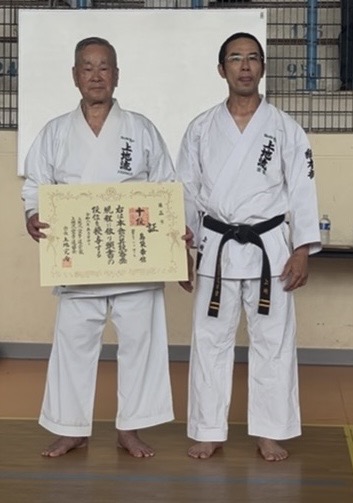
I started Uechi-Ryu karate at the age of 20 years, at the beginning of the year 1962, with Toyama Seiko Sensei. In high school, I had practiced kendo for three years, but by becoming a student at the University of the Ryukyus, I chose karate, because I had the desire to practice this martial art since my childhood.
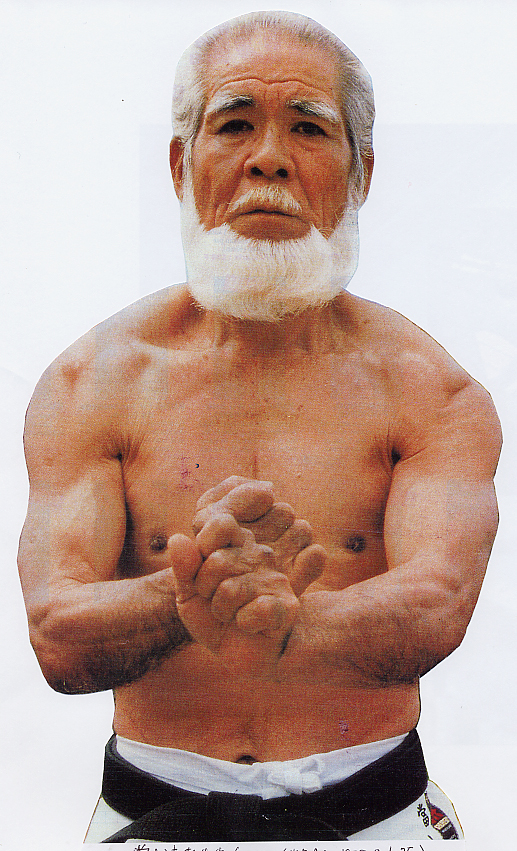
Toyama Sensei's dojo was not far from my home and Uechi-Ryu had the reputation of being a modern style, very practical and efficient in Okinawa for years 1960. Shorin-Ryu and Goju-Ryu were then considered too traditional. Le Uechi-Ryu, as for him, was seen as a new and modern style, quite simply because it emphasized jiyu-kumite (free fight), which was not generally practiced in other styles.
In our time, training took place six evenings a week. The dojos were private and installed in part of each sensei's house. We had the chance to train every day from 7:00 p.m. to 10:30 p.m.
It only took one year for the most studious students to obtain the first Dan.
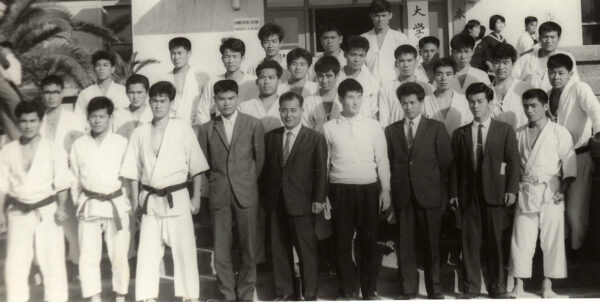
11/1965, karate demonstration at Ryukyus University, I was karate club captain.
The Soke dojo in Futenma was the center of all Uechi-Ryu dojos. It was the place for grades as well as internships. We could receive teachings from Kanei Sensei there., second generation of Soke Uechi-Ryu. Kanei Sensei spent his entire days at the dojo, dressed in his karate-gi. I remember often having the chance to benefit from almost private teaching during certain afternoons.
A March 1969, I left Okinawa for Tokyo to work. I found a job in a company manufacturing parts for nuclear power plants, where I was responsible for translating American technical documents.
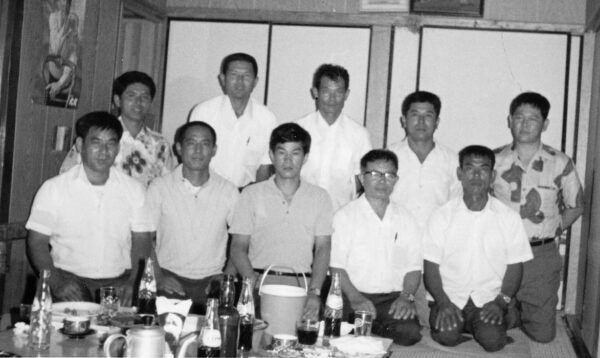
June 1971, an evening organized to encourage me when I leave for Martinique
I worked there for almost three years. At the beginning of the year 1971, I received a letter from Kanei Sensei informing me that the director of a judo institute in Martinique was looking for a karate teacher. He suggested I contact him, because I mastered English.
This news delighted me, because I had always dreamed of going abroad as a former English student. Eventually, I left for Martinique in August 1971. I stayed there two years, but unfortunately I did not have time to train a successor due to the short duration of my stay.
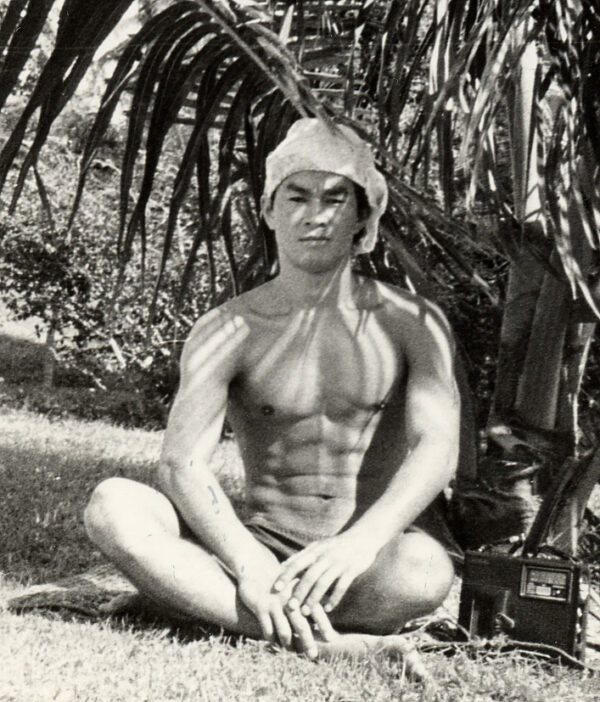
1972 in Martinique
In July 1973, I left Martinique to settle in the Lille region. At that time, karate was a still recent but extremely popular martial art. From September 1973, I started teaching Uechi-Ryu in Lille.
In July 1974, I led an internship in Slovenia. This was my first internship in a country other than France and also my first mission to disseminate Uechi-Ryu in Europe.. The small seed sown at that time has grown into a big tree today thanks to the immense efforts of Slovenian practitioners..
In June 1976, I returned to Japan with my family and settled in Tokyo, where I worked at the Crédit Lyonnais branch.
In June 1984, I returned to France with my family in order to ensure the education of my Franco-Japanese children and also because I wanted to continue the diffusion of Uechi-Ryu in France. We lived in Normandy for almost two years.
At the beginning of the year 1986, we moved to Carrières-sur-Seine, in the Paris region. I was lucky enough to be able to create a karate club there from September 1986. This was the first real step towards official teaching of Uechi-Ryu in France..
Fortunately, I got a job in a Japanese bank in Paris. Thanks to this financial stability, I could devote myself fully to teaching karate. In the middle of the years 1980, karate was already widely distributed in France. There were many clubs and teaching karate alone was not enough to support a family..
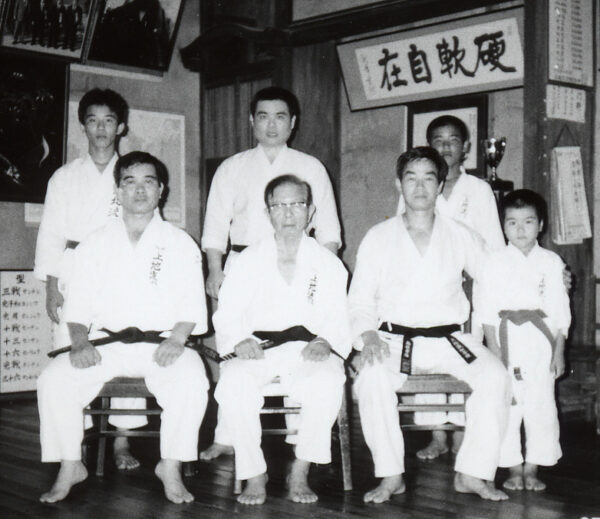
August 1985, training at Soké Dojo during my vacation in Okinawa
I took care of the Carrières-sur-Seine karate club for almost 35 years. At the same time, I have led Uechi-Ryu courses in many French regions as well as in several foreign countries, notably Belgium, Spain, Portugal, Morocco, Slovenia, Poland and Russia.
Nearly forty years have passed since my first Uechi-Ryu lessons.. Today, there are around ten Uechi-Ryu clubs in France, led by senior officers holding 6th and 7th Dan recognized by the FFKDA and by Uechi-Ryu Soke. Also in other European countries, teachers reached the grades of 6th or 7th Dan under the authority of Uechi-Ryu Soke.
My loyalty, my loyalty and attachment to Uechi-Ryu Soke have always been unwavering, although I saw many people leave the organization after the death of Kanei Sensei in 1991.
I will never forget the kindness I received from Kanei Sensei and Kanmei Sensei. I have often received almost individual teaching from Kanei Sensei, second Soke. I then received the 9th Dan from Kanmei Sensei, third Soke, then today the 10th Dan of Kansho Sensei, fourth Soke.
I am extremely proud of it, because I think that there is probably no one as privileged as me in the entire history of Uechi-Ryu.
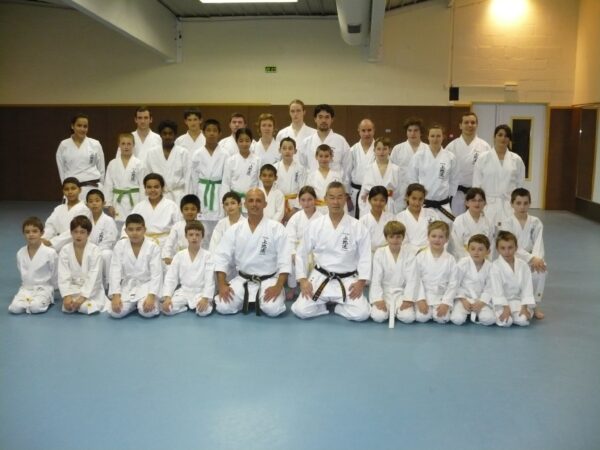
2008 – Career on the Seine
One of the reasons for my return to France was to disseminate and develop Uechi-Ryu Soké in this country as well as in the rest of Europe.. After forty years of commitment, I consider that my role is almost accomplished. French and European managers are today fully aware of their responsibilities and have all the necessary skills to continue the development of Uechi-Ryu Soké. I am convinced of it.
I thank you all very much, because this 10th Dan awarded by Uechi-Ryu Soké is also the fruit of your immense dedication and cooperation.
I also thank you in advance for your sincere consideration and for the solid unity which will allow us to continue the development of Uechi-Ryu Soké in Europe..
Y. Shimabukuro
19 June 2026